

In the cockpit


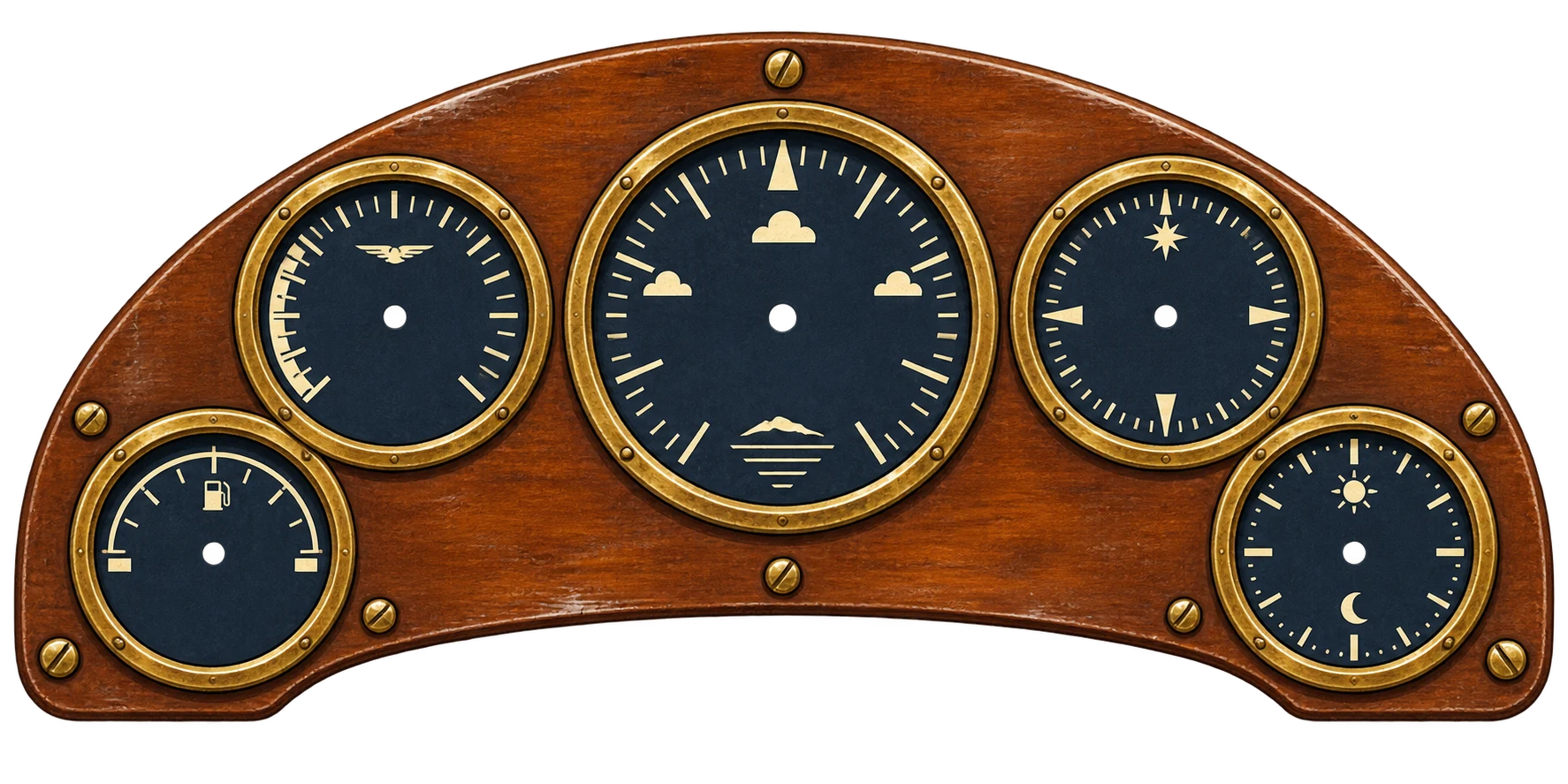
The engine is off.
The dials, in words
Start the engine and the propeller ahead spins. The throttle raises the airspeed, climbing with the stick back raises the altimeter, the pedals turn the compass, and the clock tells the real time.
Fuel gauge
The fuel gauge shows roughly how much fuel is left, and a careful pilot also looks in the tank before flying.
Fuel gauges only have to be right when they read empty, so pilots check the tanks by eye in the walk-around.
Checked against: FAA Pilot's Handbook of Aeronautical Knowledge (FAA-H-8083-25C), Ch. 7 Aircraft Systems, Fuel Gauges, p. 7-26.
Airspeed indicator
The airspeed indicator shows how fast the air is rushing past the aeroplane.
It measures speed through the air, not over the ground, from a small tube pointing into the wind.
Checked against: FAA Pilot's Handbook of Aeronautical Knowledge (FAA-H-8083-25C), Ch. 8 Flight Instruments, Airspeed Indicator (ASI), p. 8-8.
Altimeter
The altimeter tells the pilot how high the aeroplane is, by feeling how hard the air presses, which is less the higher you fly.
It works from air pressure and shows height above the sea, not above the ground: on the ground it shows the airfield's own height.
Checked against: FAA Pilot's Handbook of Aeronautical Knowledge (FAA-H-8083-25C), Ch. 8 Flight Instruments, Altimeter, pp. 8-3 to 8-7.
Compass
The compass has a magnet inside that lines up with the Earth, so the pilot can tell which way is north.
A magnetic compass points to magnetic north, which is not quite the North Pole, and it swings about in a steep turn.
Checked against: FAA Pilot's Handbook of Aeronautical Knowledge (FAA-H-8083-25C), Ch. 8 Flight Instruments, Magnetic Compass, pp. 8-23 to 8-24.
Clock
The clock tells the pilot the time, which helps them work out how long the journey is taking.
The PHAK has no clock section; the Instrument Flying Handbook lists the clock among the instruments, and pilots time legs of a journey with it.
Checked against: FAA Instrument Flying Handbook (FAA-H-8083-15B), Ch. 5 Flight Instruments, p. 5-1; FAA Pilot's Handbook of Aeronautical Knowledge (FAA-H-8083-25C), Ch. 16 Navigation, Dead Reckoning, p. 16-13.