
The Little Blue PilotEvery little dream deserves somewhere to fly.

A pilot’s logbook to print

Seven sheets to explore Little Blue’s flight notes: a checklist for before you fly, a log of your flights, the things every pilot knows, a word search of flying words, a page for your own aeroplane, and a scene to colour.

A4 or Letter paper, one sheet to a page, in black ink.

My Pilot’s Logbook

Pilot:

Made from Little Blue’s flight notes, at littlebluepilot.com

My Pilot’s Logbook

Before every flight

For a bedroom, a garden, a cardboard box or the back seat of the car. Read it out loud, top to bottom, the way pilots do.

  1. WeatherLook out of the window. Sunny, cloudy, windy? Say it out loud.
  2. Walk-aroundWalk all the way round your aeroplane. Wings? Wheels? Anything loose?
  3. Goggles onAnd a scarf, if you have one. Real pilots wore both.
  4. Strap inSeat belt tight. Door shut.
  5. ChecklistRead this list out loud, from the top. Pilots read theirs every single time.
  6. “Clear!”Say it loudly, so everybody steps back from the propeller.
  7. Deep breathFace into the wind. Count to three.
  8. Off you popThe runway rushes. The wheels lift. There you go.

Goggles on. Deep breath. There you go.

My Pilot’s Logbook

My flights

Real pilots write their flights down in a logbook. Write yours here: where you flew, and what you saw.

My flights, a table to fill in by hand
DateMy aeroplaneWhere I flewThe weatherWhat I saw

My Pilot’s Logbook

Things every pilot knows

Tick each one when you know the answer.

  1. Are small wings enough?Yes. Every bird’s wings are shaped for its own way of flying: quick turns, long journeys, hovering or gliding. And small wings are exactly right for a small flyer.
  2. How does a wing hold anything up?A wing is shaped and tilted so that, as it moves, it pushes air downwards, and the air pushes the wing up. That push is called lift.
  3. What does a pilot do before takeoff?Before takeoff a pilot checks the weather, walks all the way around the aeroplane, reads a checklist out loud, and only then starts the engine.
  4. What is a tailwind?A tailwind is wind moving in the same direction you are travelling. It comes from behind and pushes you along.
  5. What are clouds made of?Clouds are billions of water droplets, each too small to see on its own, made when rising air cools. And on the greyest day, the sun is still shining above them.
  6. What do the dials in a cockpit tell a pilot?How fast the aeroplane is going, how high, which way, whether it is level, and how the engine is doing: the things a pilot cannot judge for certain by feel.
  7. Why do pilots watch the horizon?Because it is the steadiest thing in the sky: where the horizon sits in the windscreen tells a pilot at a glance whether the aeroplane is level, climbing, diving or turning.
  8. What do pilots do when a storm is coming?They keep well away from it. Pilots check for storms before they fly, go around one or turn back if they meet it, and wait for it to pass, which most storms do within the hour.
  9. How does a pilot hold a line in the wind?When the wind pushes an aeroplane sideways, the pilot points it a little into the wind, so that it still travels straight along the line they chose.
  10. What is turbulence?Turbulence is air moving unevenly, in gusts and swirls and sudden rises and drops. It makes an aeroplane bump and shake, and aeroplanes are built to fly through it.
  11. Is a pilot ever alone up there?Hardly ever. Pilots talk by radio to people on the ground whose job is to help them, other pilots listen on the same channels, and some fly beside a friend on purpose.
  12. How does a pilot land an aeroplane?The pilot lines up with the runway, facing into the wind, slows down and glides towards it, then gently raises the nose just above the ground so the wheels settle rather than bump.

My Pilot’s Logbook

Flying words

There are 13 flying words hidden here. Each one reads across or down. Tick it when you find it.

  • Thermal: a bubble of warm air rising from the ground. Great birds and gliders ride them upwards.
  • Lift: the upward push the air gives a moving wing.
  • Tailwind: wind from behind, pushing you along.
  • Windsock: the striped cone at the airfield that shows which way the wind is going.
  • Cumulus: the heaped, puffy clouds of a sunny day.
  • Altimeter: the dial that shows how high you are.
  • Horizon: the line where the sky seems to meet the land or the sea.
  • Anvil: the flat, spread-out top of a thunderstorm cloud.
  • Crosswind: wind blowing across your path, from one side.
  • Turbulence: air moving unevenly, which makes an aeroplane bump.
  • Gust: a sudden, short rush of wind.
  • Mayday: the word a pilot says three times on the radio in a real emergency. It comes from the French for “help me”.
  • Flare: gently raising the nose just above the runway, so the wheels settle softly.

My Pilot’s Logbook

My aeroplane

Draw your aeroplane here.

Its name:

My Pilot’s Logbook

Back at the hangar

A quiet place after a day in the sky. Colour the aeroplane and its home.
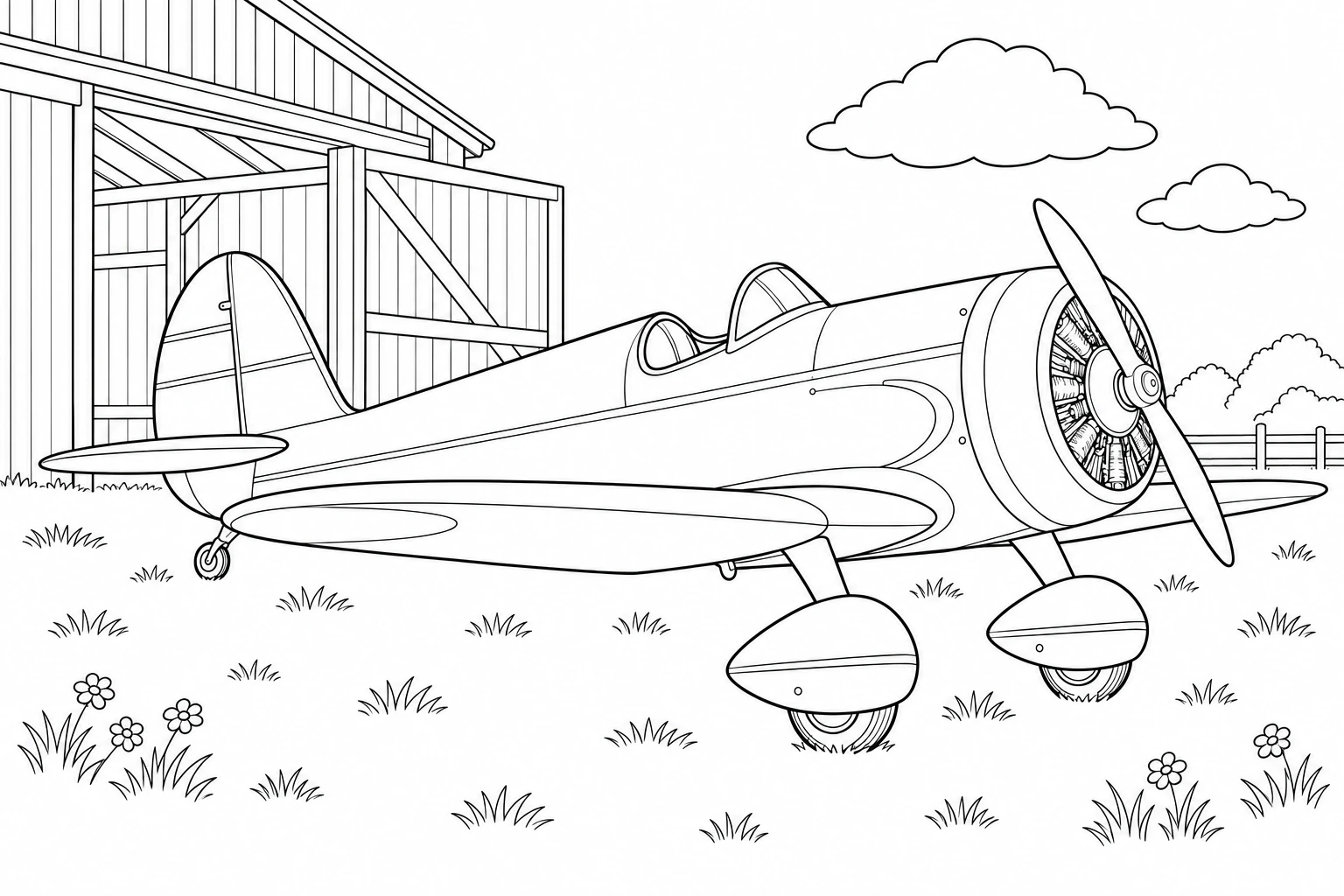
Outline drawing to colour: a vintage propeller aeroplane parked in the grass beside a wooden hangar, with clouds and daisies.