

What do the dials in a cockpit tell a pilot?
How fast the aeroplane is going, how high, which way, whether it is level, and how the engine is doing: the things a pilot cannot judge for certain by feel.
 Open this chapter in the storybook
The short version
In the air, a pilot cannot always trust their own feelings. In a slow, gentle turn you can feel exactly as if you are flying straight, and inside a cloud your body cannot tell which way is up. The dials are there so a pilot never has to guess.
In most small aeroplanes six main dials sit together right in front of the pilot, laid out in the same pattern in nearly every cockpit, so a pilot who climbs into a different aeroplane still knows where to look.
The six
- Airspeed: how fast the aeroplane is moving through the air. A small tube pointing forward from the wing catches the rushing air and works the needle.
- The altimeter: how high the aeroplane is. It works by measuring the pressure of the air, which gets lower the higher you go.
- The artificial horizon: a little picture of sky above and ground below that stays level with the real ones, with a tiny aeroplane drawn across it. When cloud or darkness hides the real horizon, this is the one the pilot flies by.
- Heading: which way the nose is pointing: north, south, east, west and everything in between. A compass sits nearby too.
- Climb and descent: whether the aeroplane is going up or down, and how quickly.
- The turn: whether the aeroplane is turning, and whether the turn is smooth: a little ball in a curved glass tube should sit in the middle, like a bubble in a spirit level.
Around them are the engine’s own dials: how fast the propeller is turning, the oil’s temperature and pressure, and how much fuel is left. Newer aeroplanes often draw all of this on screens instead, but they are still answering the same questions.
Looking, and looking out
Pilots do not stare at any one dial. Their eyes run round them in a loop, a glance at each, and then out of the window again. That loop is called a scan, and it keeps going for the whole flight. When the sky is clear, most of a pilot’s looking is out of the window, at the horizon; the dials are how they check it.
And the wheel
In front of the dials is what the pilot steers with: a control wheel, or a stick. Pull it back and the nose rises. Push it forward and the nose goes down. Turn it and the aeroplane tips its wings and turns. The pilot’s feet rest on two pedals that swing the tail from side to side, to keep the turns tidy.
In the story
Everything above is true of real cockpits. This part is Little Blue’s world.
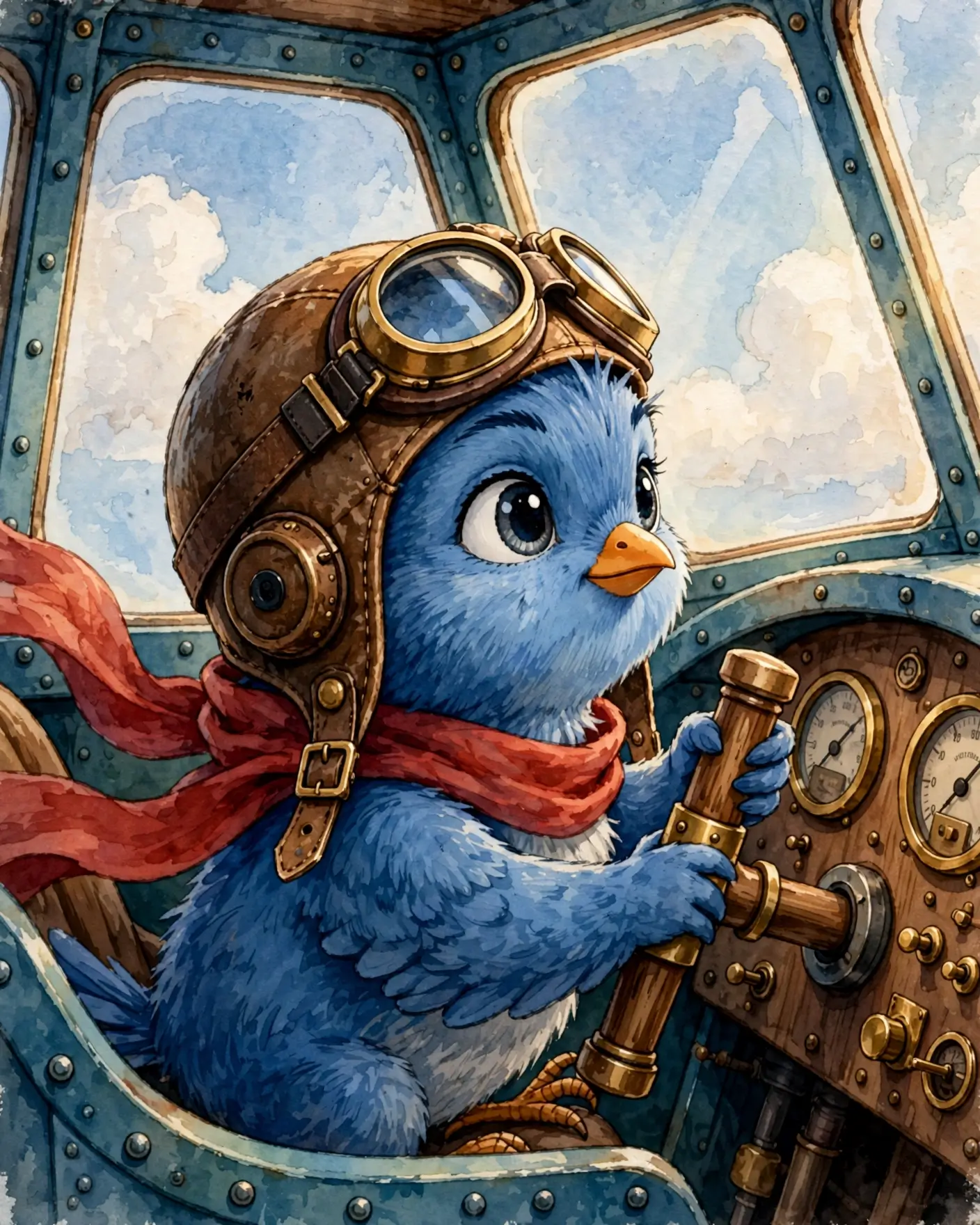
Chapter five is practice, day after day. Little Blue wobbles, and some of his landings are bumpy, as every new pilot’s are. He checks his dials and keeps his wings on the wheel, and, catching his own reflection in the glass, he says it quietly to himself: “I’m a pilot.”
The title song meets the same wheel in a storm: the world spun the wheel, and the little bird steered. The dials tell you what is happening. The wheel is how you answer.
Three words to keep
- Altimeter: the dial that shows how high you are.
- Artificial horizon: the dial that shows whether the wings are level and the nose is up or down.
- Scan: the loop a pilot’s eyes make around the dials, again and again.