
What is turbulence?
Turbulence is air moving unevenly, in gusts and swirls and sudden rises and drops. It makes an aeroplane bump and shake, and aeroplanes are built to fly through it.
 Open this chapter in the storybook
The short version
Air flows like water, and like water it is not always smooth. Think of a stream: glassy where it runs deep and straight, churning where it tumbles over rocks. Air churns too, in gusts and swirls, in patches that rise and patches that sink, and an aeroplane flying through churning air gets bumped about the way a boat bumps on choppy water. That bumpiness is turbulence.
Where it comes from
- Sunshine. The ground warms unevenly and bubbles of warm air rise off it, so flying low on a hot afternoon is often bumpy.
- Hills, mountains and buildings. Wind blowing over them tumbles on the far side, like water over rocks.
- Storms. In and around a thunderstorm, air rushes up and down harder than anywhere else, which is one reason pilots stay well away from them.
- Clear sky. High up, where fast rivers of wind slide past slower air, there can be bumps with not a cloud in sight.
What pilots do
First they slow down a little, to a speed chosen for rough air, so each bump is gentler on the aeroplane. Then they keep the wings level and the nose steady, and they do not chase every bump. If a gust lifts the aeroplane a little, or lets it drop, the pilot lets it happen and eases it back, rather than wrenching at the controls to fight each one. Small, calm corrections, over and over. And everybody on board keeps their seat belt fastened, which is what the seat belt sign is for.
Built to bend
Aeroplanes are built for rough air. Their wings are made to flex, bending up and down and springing back, the way a tree bends in the wind instead of snapping. Look out of an airliner’s window on a bumpy day and you may see the wingtip gently bouncing. It is supposed to.
In the story
Everything above is what real pilots do. This part is Little Blue’s world.
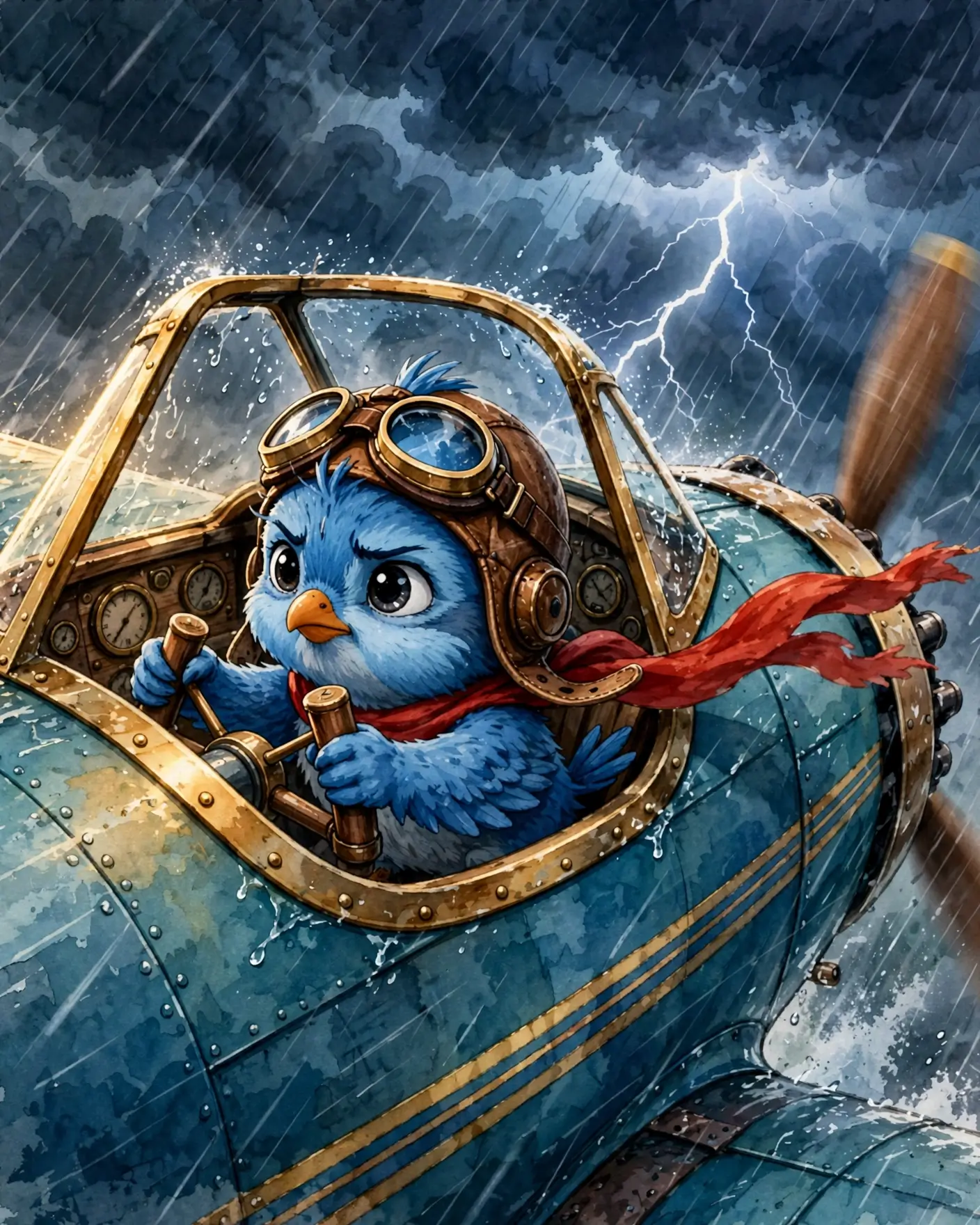
Chapter nine is the worst of the storm. The aeroplane is shaking, rain and lightning come all at once, and Little Blue feels tiny again. What gets him through is what gets pilots through rough air: not one big fight, but small, steady steps, with the girl’s words from the beginning of the book in his mind. The book puts it in three: “One breath. One turn. One moment at a time.”
The title song tells the whole storm in four lines, and the last of them is this note in a line: the world spun the wheel, and the little bird steered. You cannot stop the air from pushing. You can keep steering.
Three words to keep
- Turbulence: air moving unevenly, which makes an aeroplane bump.
- Gust: a sudden, short rush of wind.
- Updraft and downdraft: air moving up, and air moving down. Thunderstorms have strong ones of both.
Why pilots keep away from the roughest air of all: what do pilots do when a storm is coming?