What does a pilot do before takeoff?
Before takeoff a pilot checks the weather, walks all the way around the aeroplane, reads a checklist out loud, and only then starts the engine.
 Open this chapter in the storybook
First, the weather
A pilot looks at the sky before they look at the aeroplane. Which way is the wind blowing, and how hard? Are the clouds high and thin, or low and heavy? Is there rain on the way? Pilots read the weather report and then go outside and check it against the real thing, and if the sky is wrong, the flight waits. Nobody argues with weather. You read it.
The walk-around
Then the pilot walks all the way round the aeroplane, slowly, looking and touching. The wings: nothing loose, nothing bent, and nothing frozen on them — dew is fine, ice is not. The bits that move, on the wings and the tail, moved by hand to make sure they swing freely. The tyres. The propeller, run along with a fingertip for nicks. The fuel, which they look at with their own eyes, and the oil.
They do this even on an aeroplane they flew yesterday. Especially then. The walk-around is not for finding things that are usually wrong; it is for the one morning something is.
Strapping in, and the checklist
Seat adjusted, straps pulled tight, door shut and latched. And then the checklist: a written list, read out loud, item by item, in order, every single time. Pilots who have flown a thousand times still read it. The point of a checklist is not remembering. The point is not having to remember, so that all of your attention can go on flying.
Many pilots also say the plan out loud before they go — where they are flying, which way, what they will do if something changes — even if the only person listening is themselves. That is called a brief.
“Clear!”
Before the propeller turns, the pilot opens the window and calls it out — “Clear prop!” — so that anyone near the aeroplane knows to step back. Only then does the engine start: a cough, a sputter, and a roar.
To the runway, into the wind
The aeroplane taxis slowly to the end of the runway. One last check with the engine running and the brakes on, and then the pilot turns to face straight into the wind — because an aeroplane takes off into a headwind, which lifts it sooner and more gently (here is why). A deep breath. Then the runway rushes underneath, and the wheels lift.
In the story
Everything above is what real pilots do. This part is Little Blue’s world.
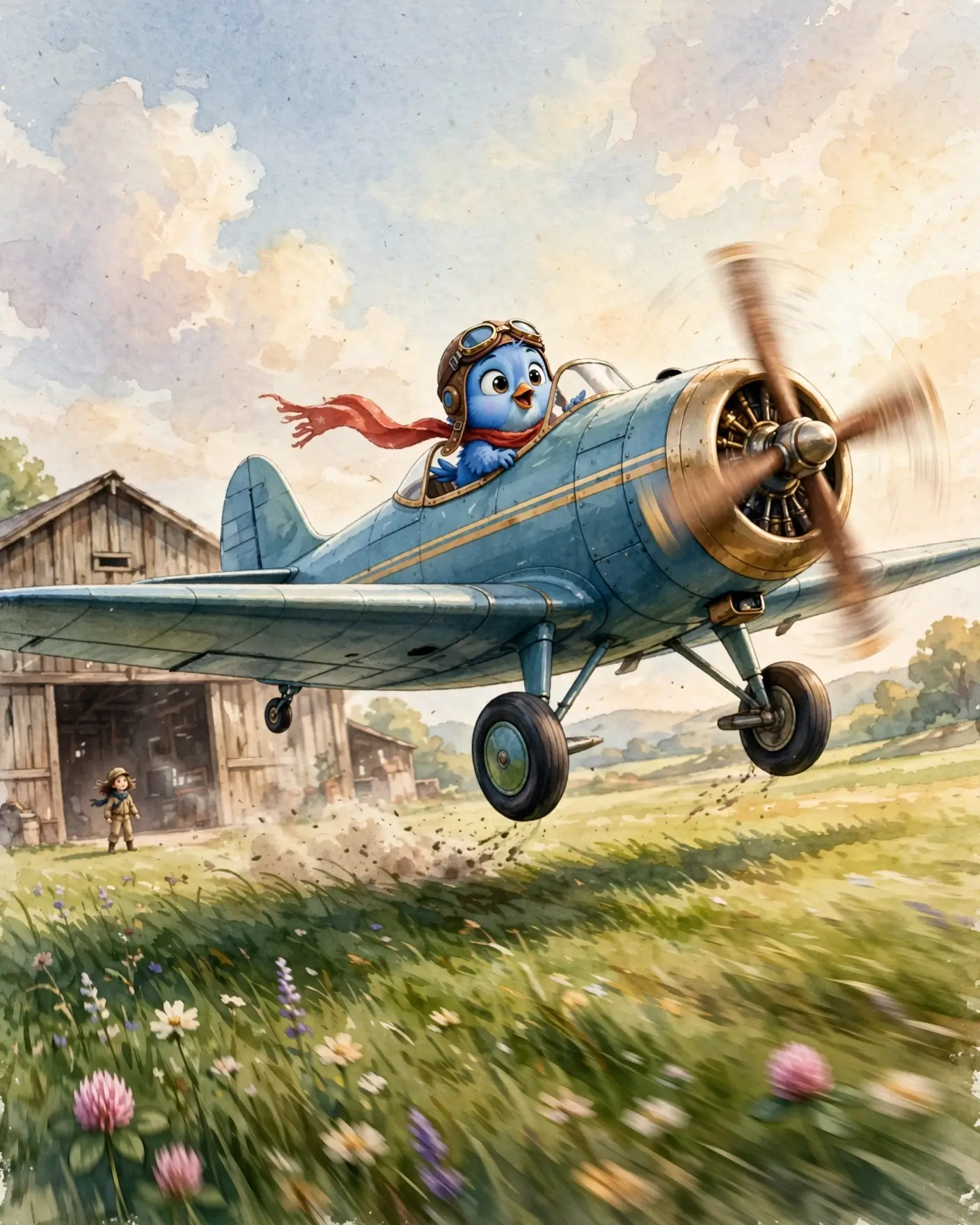
Chapter two of the storybook is this morning exactly: goggles, red scarf, little blue aeroplane, and enormous nerves. The engine sputters, then roars; the runway rushes beneath him; the wheels lift. And the first words of the whole record, in First Wings, are somebody else doing up the strap: Goggles on. Deep breath. There you go. Nobody starts alone.
Wingtips and Dew is a whole song of the walk-around, at first light on an empty tarmac: so I brief it, and I scan it, a checklist in his head, quiet in the cockpit. The most serious song on the album is about the careful small jobs nobody claps for.
A checklist for a flight of your own
For a bedroom, a garden, a cardboard box or the back seat of the car. Read it out loud, top to bottom, the way pilots do. This page prints, and the boxes are for ticking.
- WeatherLook out of the window. Sunny, cloudy, windy? Say it out loud.
- Walk-aroundWalk all the way round your aeroplane. Wings? Wheels? Anything loose?
- Goggles onAnd a scarf, if you have one. Real pilots wore both.
- Strap inSeat belt tight. Door shut.
- ChecklistRead this list out loud, from the top. Pilots read theirs every single time.
- “Clear!”Say it loudly, so everybody steps back from the propeller.
- Deep breathFace into the wind. Count to three.
- Off you popThe runway rushes. The wheels lift. There you go.
Goggles on. Deep breath. There you go.