Are small wings enough? How birds fly
Yes. Every bird’s wings are shaped for its own way of flying: quick turns, long journeys, hovering or gliding. And small wings are exactly right for a small flyer.
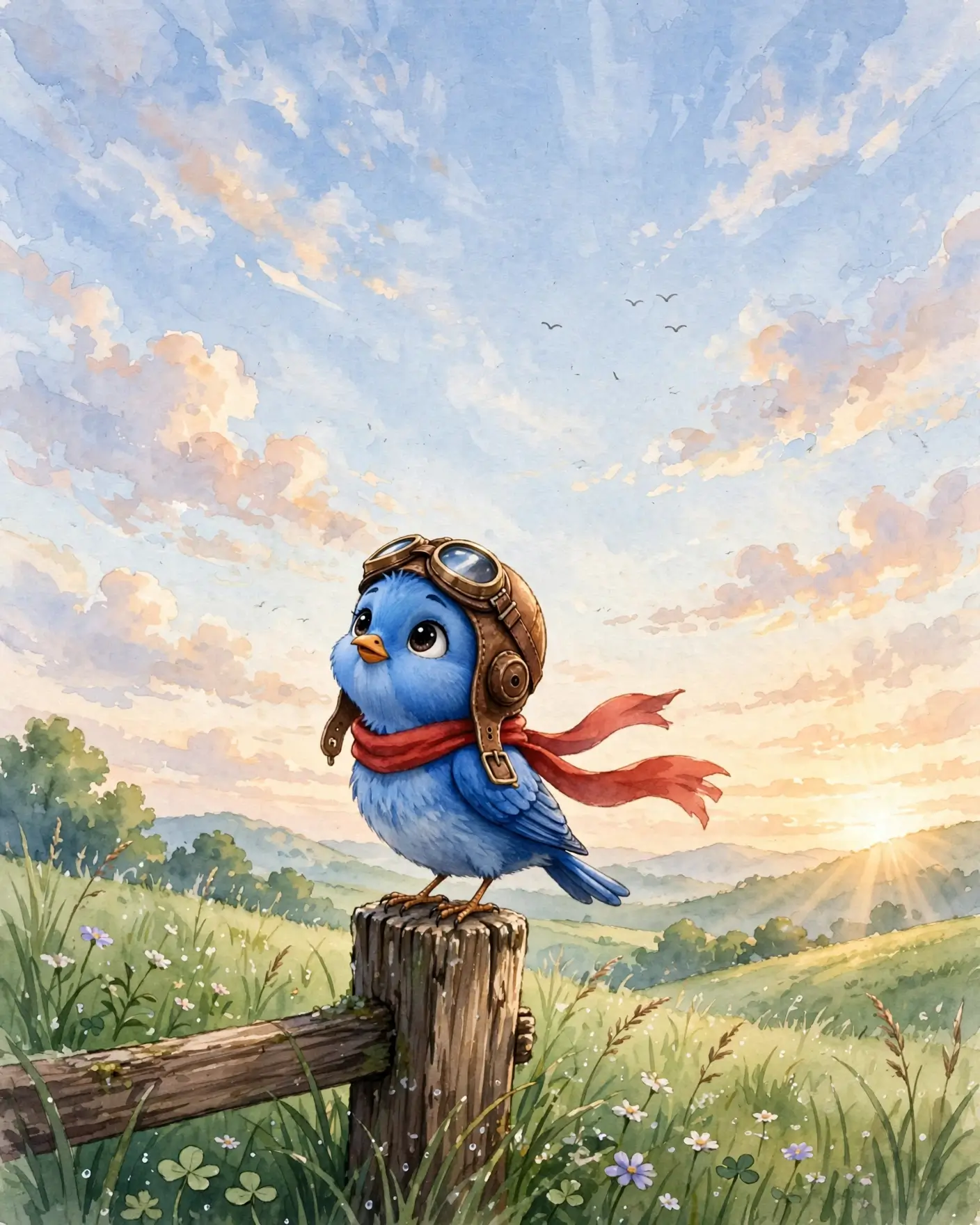 Open this chapter in the storybook
The short version
Birds do not all fly the same way, because they do not all need to. A wing is shaped for a job. Long, pointed wings are built for speed and sharp turns. Long, broad wings are built for gliding for hours with hardly a flap. Short, rounded wings are built for leaping into the air in a hurry. And the smallest wings of all can do something few other birds can manage: stay in one place in mid-air.
So the size of a wing is only half of the story. What matters is whether it suits the flyer carrying it, and a small bird is light. For a small flyer, small wings are exactly enough.
Four birds, four ways of flying
- Swallows have long pointed wings and a forked tail they steer with like a rudder. They catch insects in mid-air, so they twist and turn at speed, and a flock swerves together.
- Geese travel in a V. Each goose flies a little behind and to one side of the one in front, where the air curling off that bird’s wingtip gives it a small lift for free. It makes a long journey easier for the whole flock, and they swap places, because the front is the hardest place to fly.
- Hummingbirds beat their wings dozens of times every second, sweeping them forward and back in a figure of eight. That lets them hover in front of a flower, and even fly backwards.
- Great birds such as eagles and storks hardly flap at all. They find bubbles of warm air rising from sunny ground, called thermals, and circle up inside them without working, then glide a long way to the next one.
Aeroplanes do all four
Flying machines come in the same variety, for the same reason. A glider has long wings for soaring, like a great bird’s, and climbs on thermals with no engine at all. An aerobatic aeroplane is built to twist and roll at speed, like a swallow. A helicopter hovers. And pilots who fly together often do it in a V of three, which they call a vic.
In the story
Everything above is true of real birds and real aeroplanes. This part is Little Blue’s world.
The book opens with all four. Every morning Little Blue watches from the fence: swallows turning together, geese in formation, hummingbirds dancing, great birds gliding far above him. Then he looks down at his own tiny wings and asks the question the whole story answers: “Are my wings enough?”
In chapter three he finds out from the middle of the flock. A swallow zips past, the geese glide steady in their V, a hummingbird hovers in place, and none of them fly the same way. Little Blue learns that “there is no single right way to move through the sky.” In Tailwind (Up, Up, Up) the gang turns it into a game, Can you flap? Can you glide?, and both answers count.
Three words to keep
- Thermal: a bubble of warm air rising from the ground. Great birds and gliders ride them upwards.
- Formation: flying together in a planned shape, each flyer in its own place. A V is one.
- Hover: staying in one spot in the air. Hummingbirds can; most birds cannot.
Geese on a long journey also wait for a wind that is going their way: what is a tailwind?