
Why is the sky blue?
Sunlight is every colour mixed together. The tiny pieces that make up the air scatter its blue light all over the sky far more than its red, so blue reaches your eyes from every part of the sky.
 Open this chapter in the storybook
The short version
The Sun sends us light made of lots of colours mixed together. As sunlight travels through the air, the tiny, tiny bits that air is made of bounce the blue light off in every direction, much more than the other colours. So wherever you look up, blue is coming towards you, and the sky looks blue.
And when the Sun is low, near the edge of the sky, we sometimes see orange, pink and golden skies.
Why does the air scatter blue light?
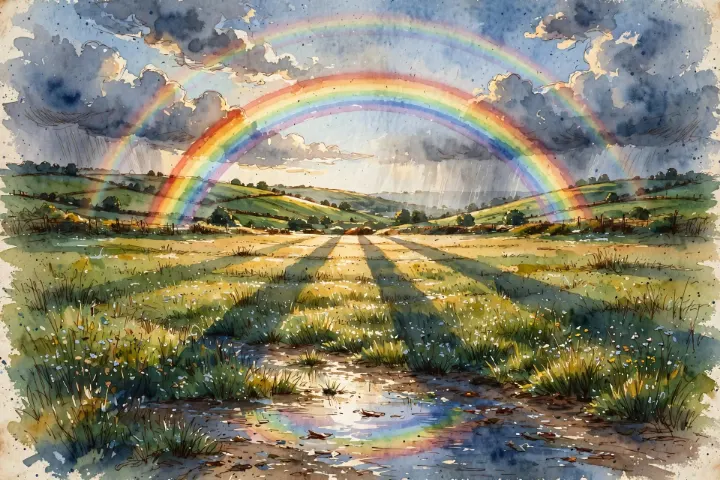
Sunlight looks white, but it is every colour of the rainbow mixed together: a rainbow is sunlight split up so that you can see its colours, in order, which is called its spectrum. Light travels in waves, and each colour has its own length of wave: red’s are the longest, blue’s and violet’s the shortest.
Think of waves on a pond meeting a tiny pebble: long, slow waves roll on past it, while short, quick ripples bounce off it. The bits that air is made of are far smaller than any wave of light, and they do something like the same thing, sending short blue waves bouncing off in every direction several times more than long red ones. That is called scattering, and it fills the whole sky with blue.
Why isn’t the sky purple?
Violet light has even shorter waves, and the air scatters it even more than blue. But sunlight has less violet in it to begin with, and our eyes are much better at seeing blue than violet. The light that comes to us from the sky is a mixture, mostly blue with some violet and a little green, and our eyes and brain see that mixture as sky blue.
Why are sunsets often orange and red?
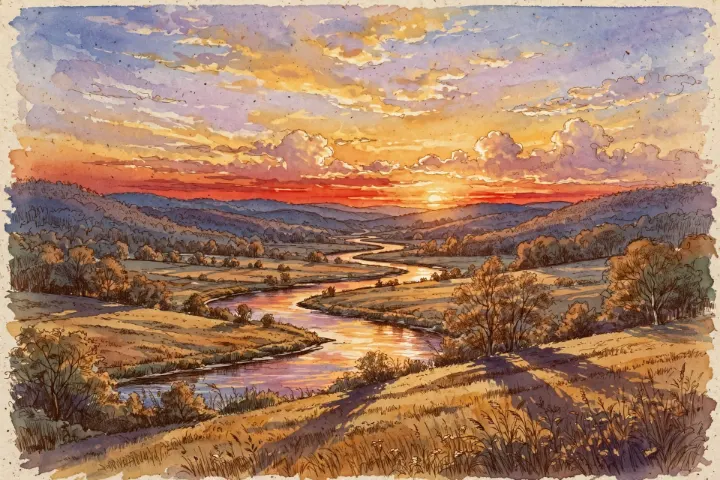
When the Sun is low, its light comes to you sideways, through far more air than it crosses at midday. On that long way more and more of the blue is scattered out of the sunbeam before it arrives, which often leaves the yellow, orange and red. Clouds catch that light and glow pink and gold, and the sky above them can turn lilac.
Not every sunset is fiery. How colourful it is depends on the air that day: dust, haze and clouds can deepen the colours, or leave the sky pale.
Try it with a grown-up: a sunset in a glass
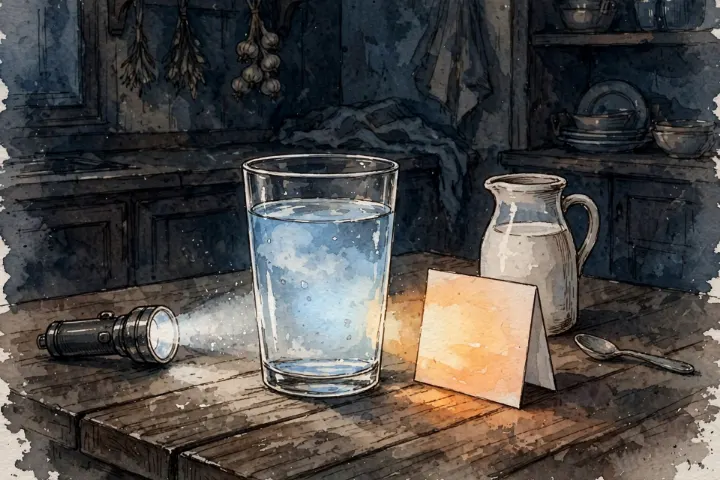
You need a clear glass of water, a few drops of milk, an ordinary small torch, and a white card or a pale wall. With a grown-up, stir the milk into the water, make the room a little darker, and shine the torch through the side of the glass onto the card. Never shine a torch into anyone’s eyes, and don’t look into it yourself.
Look at the water from the side: it may have a faint blue tinge. Now look at the light on the card: it may be yellow or orange, like a sunset. The tiny specks of milk scatter the blue a little the way the air does. It is only a small model of the sky, and what you see depends on the glass, the milk and the torch: if nothing changes, try a few more drops of milk, or fewer.
No torch? Look at a clear blue sky, but never at the Sun: the blue straight above you is deeper than the paler blue near the horizon, where the light has crossed far more air on its way to you.
If the sky is blue, why are clouds white?
A cloud’s droplets are far bigger than the bits that air is made of, big enough to scatter every colour alike. So a cloud scatters all the colours of sunlight together, and all the colours mixed together look white. A thick cloud can look grey underneath, because so much light is scattered back up and out of its sides that little gets through to its base (what are clouds made of?).
What colour is the sky high up?
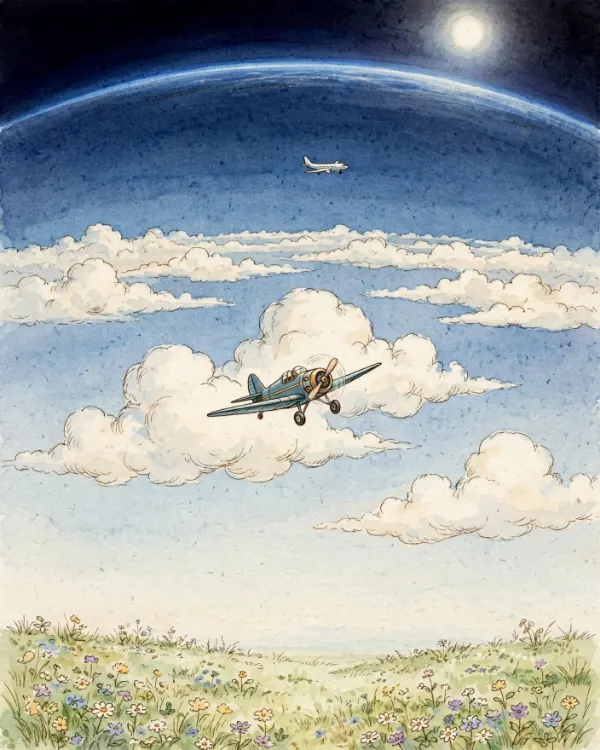
The higher you climb, the less air there is above you to scatter the light, so the sky turns a deeper, darker blue. From a small aeroplane it still looks an ordinary blue. From an airliner far above the clouds it is a deep blue, darker than any sky you see from the ground. Only much higher still, far above where any airliner flies, does it fade to black: in space, where there is almost no air at all, the sky is black even with the Sun shining.
In the story
Everything above is true of every sky. This part is Little Blue’s world.
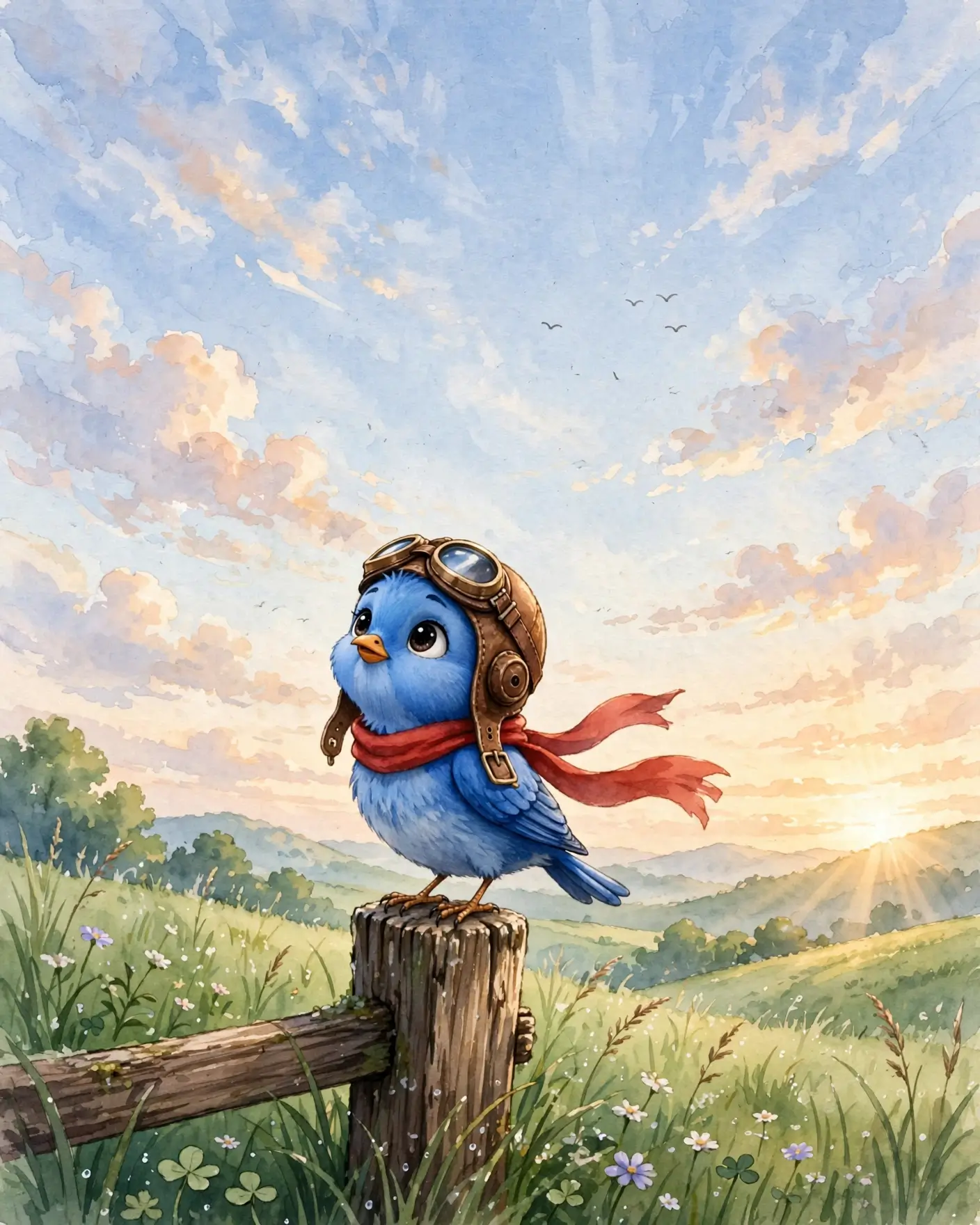
“Little Blue is a very small blue bird with a very big dream,” and the book begins with the sky he dreams of: “Every morning he sits near the fence and watches the sky.” Higher Than the Clouds climbs right through the grey into the blue.
In chapter twelve he comes home at sunset: “The sun is setting now. The old hangar glows with warm light.” And the next morning, in the book’s own words, “the sky is still enormous.” The theme, The Little Blue Pilot (Sunshine Squad Remix), sings it outright: Little blue pilot, big blue sky!
Three words to keep
- Scatter: to send light bouncing off in every direction.
- Spectrum: all the colours sunlight is made of, in order, the way a rainbow shows them.
- Atmosphere: the blanket of air around the Earth, thinner the higher you go.
For curious grown-ups
Where the facts above were checked: