

What do pilots do when a storm is coming?
They keep well away from it. Pilots check for storms before they fly, go around one or turn back if they meet it, and wait for it to pass, which most storms do within the hour.
 Open this chapter in the storybook
The short version
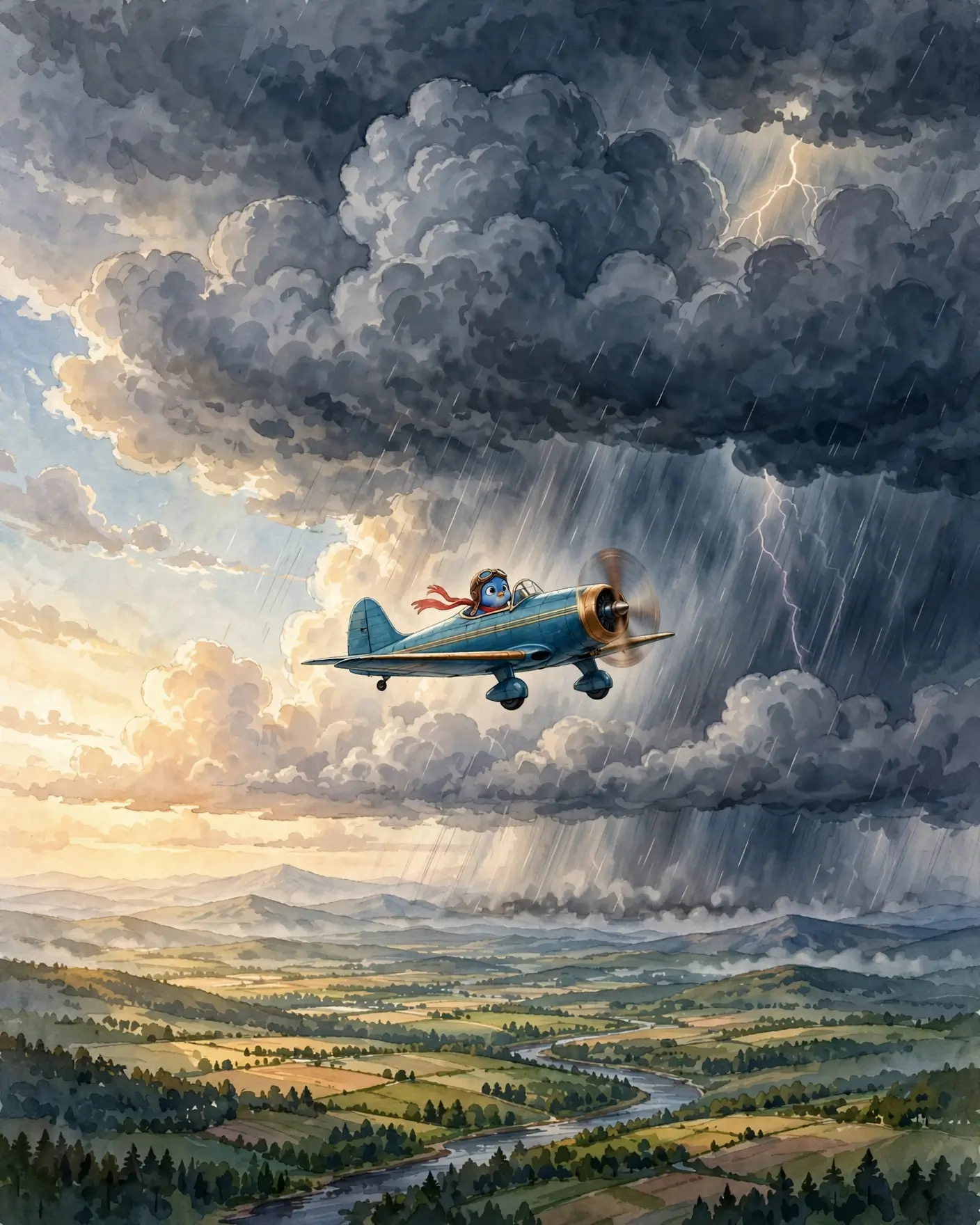
A thunderstorm is a cloud that has grown enormous. It starts as a puffy heap on a warm day and keeps building as warm, damp air rushes up inside it, until it is often taller than the highest mountains, with a flat top spread out like a blacksmith’s anvil. Inside, air races up and pours down at the same time, rain and hail form, lightning flashes, and thunder is the sound the lightning makes.
How you can tell one is coming
- The clouds pile up high and turn dark underneath.
- The light changes: the sky goes dim, sometimes with a strange tint to it.
- The air suddenly turns cooler and a gust of wind arrives, often just before the rain. That cold gust is air rushing out from underneath the storm.
- You hear thunder. If you can hear it, the storm is close.
What pilots do
Pilots take thunderstorms more seriously than almost anything else in the sky, because the air in and around them is violently bumpy, and there can be hail and lightning. So they do not fly into them. Before a flight they read the forecast and look at the weather radar. In the air they give a storm a very wide berth, many kilometres, and fly around it, or turn back, or land somewhere and wait. Even the biggest airliners go around thunderstorms.
Turning back is not giving up. Pilots plan for it before they take off, deciding where they will turn round if the weather is wrong, and a pilot who turns back from a storm has made a good decision that every other pilot respects.
How a storm ends
A storm cannot keep going for ever. It is fed by warm air rising into it, and once the rain, and the cold air falling with it, pour down harder than the warm air can rise, the storm is cutting off its own supply. It rains itself out. Most single thunderstorms are over in less than an hour: the cloud thins, the rain eases, and the sun comes back through. Often the wisest thing to do about a storm is to wait for it.
In the story
Everything above is what real pilots do. This part is Little Blue’s world: in the book’s own words, “A story about a small dream meeting fear, storms, and learning to read the weather.”
Chapter seven has every sign above, in the order a pilot would notice them: the cold air, the changing light, the wall of cloud ahead. Little Blue’s heart beats fast, and two voices argue inside him. One says “Turn back.” The other, braver, says “Keep looking ahead.”
In a real aeroplane there is no argument. Keeping your eyes on what is ahead is how a pilot reads the weather, and when what is ahead is a thunderstorm, a real pilot turns back or goes around it, every time. Little Blue flies on because this is a story: his storm is the book’s way of showing a very small pilot finding his courage, not a lesson in how to fly. In Read the Storm the little pilot wonders it out loud, I think I’ll just… turn back?, and the song never calls that cowardly.
In chapter eleven the storm ends the way storms do. The clouds open “like a curtain pulling back,” the sun comes through, and the chorus of Read the Storm turns out to have been telling the truth all along: the storm will tire out first, little bird… not you.
Three words to keep
- Thunderstorm: a towering cloud with lightning, thunder, heavy rain and very rough air inside.
- Anvil: the flat, spread-out top of a thunderstorm cloud.
- Divert: to fly somewhere other than planned, because of the weather or anything else. A good decision, not a failure.
Why storms shake an aeroplane so much: what is turbulence?