

How does a pilot land an aeroplane?
The pilot lines up with the runway, facing into the wind, slows down and glides towards it, then gently raises the nose just above the ground so the wheels settle rather than bump.
 Open this chapter in the storybook
The short version
Landing is the part of flying that pilots practise most, because it asks for the most care: the aeroplane has to meet the ground slowly, gently and in exactly the right place. It happens in a few steps, and each one on its own is simple.
Lining up
First the pilot flies a loop around the airfield, a big rectangle in the sky called the circuit, so they can see the runway, the windsock and anyone else flying nearby. The last turn brings them in line with the runway, pointing straight down the middle of it. That straight last stretch is called final.
They land into the wind, for the same reason they take off into it: with a headwind the aeroplane is moving more slowly over the ground when the wheels touch, so it needs less runway and arrives more gently (more about that).
Slowing down, gliding in
On final the pilot takes off some of the engine’s power and lets the aeroplane come down on a gentle, steady slope, like a long slide, aimed at a spot near the start of the runway. The wheels have to be down: on many small aeroplanes they are fixed underneath and always down, and on others the pilot lowers them and checks for three green lights that say they are locked.
The flare
Just above the runway comes the moment that makes a landing soft. The pilot takes off the last of the power and gently raises the nose, a little at a time, so the aeroplane stops coming down and floats just above the ground, slowing as it goes, until the wheels settle onto it. That is called the flare. Too early and the aeroplane floats and then sinks; too late and it bumps. Every pilot’s first landings are a bit bumpy.
Then the aeroplane rolls along the runway, rumbling if the runway is grass, slows to walking pace and turns off towards the place it will park.
In the story
Everything above is what real pilots do. This part is Little Blue’s world.
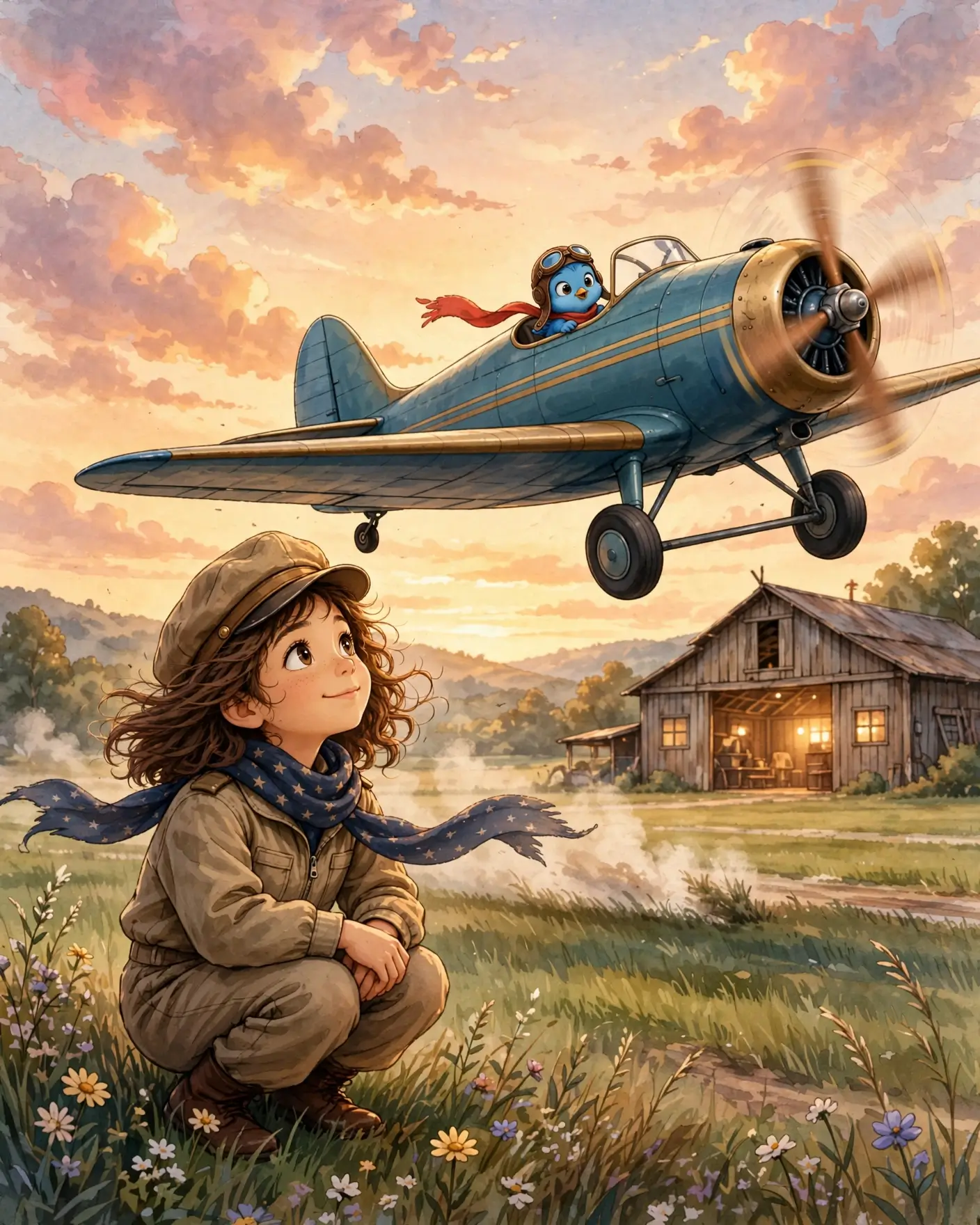
Chapter twelve is a real landing, told in three sentences a pilot would recognise: “Little Blue lines up the runway. His wheels touch gently. Grass rushes beneath him.” It is sunset, the old hangar where the story began is lit up, and the girl is waiting on the grass.
Wheels Down is the same landing, sung: Slow it down, glide it in, soft as a falling feather. And it says why he is landing, which is not because he is tired out but because he chose to come home.
Three words to keep
- Circuit: the rectangle pilots fly around an airfield before landing.
- Final: the last straight part of the way in, lined up with the runway.
- Flare: gently raising the nose just above the runway, so the wheels settle softly.